How to Price a Product: A Step-by-Step Method for Small Businesses
Work out your true unit cost, choose a pricing method, sense-check it against competitors and test it, with a worked example you can copy.
On this page
- Why pricing deserves your attention
- Step 1: Work out the true cost of one unit
- Step 2: Choose your pricing method
- Step 3: Set a margin that covers your goals
- Step 4: Check the market
- Step 5: Think about value, not just cost
- Step 6: Test, then adjust
- A worked example
- Small presentation choices that matter
- When and how to raise prices
- Show the price professionally
Most small businesses set prices once, by copying a competitor or adding a round number to the supplier's price, and then never touch them again. That's how a busy shop ends the year with less money than expected. Learning how to price a product properly takes an afternoon and pays back every month after.
Here's the six-step method we recommend, with a worked example you can adapt to your own product.
Why pricing deserves your attention#
Price is the lever with the biggest effect on profit. McKinsey's widely cited analysis, "The power of pricing", found that for the average large company a 1% price increase, with volume unchanged, lifted operating profit by about 8.7%. Small businesses usually have thinner margins, so the effect of getting price right is often bigger, not smaller.
Step 1: Work out the true cost of one unit#
Start with every cost that goes into one sale, not just what you paid the supplier:
- Direct costs: materials or stock, packaging, transport to your shop, import duties.
- Per-sale costs: payment fees, delivery, the paper bag, the free sample.
- A share of overheads: rent, salaries, electricity, internet and software, divided by the number of units you expect to sell.
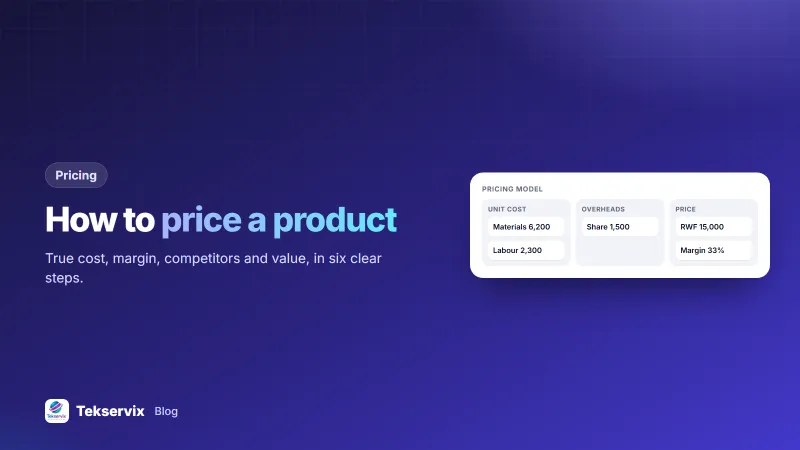
The overhead share is the part people skip, and it's why "I'm selling a lot but have no money" is such a common complaint. If your monthly overheads are RWF 900,000 and you sell 600 units a month, each unit must carry RWF 1,500 of overhead before it makes any profit.
Step 2: Choose your pricing method#
| Method | How it works | Best for |
|---|---|---|
| Cost-plus | Unit cost plus a fixed margin | Stock that's easy to compare, simple products |
| Competitor-based | Set around what others charge | Crowded markets where buyers compare prices |
| Value-based | Price by what the result is worth to the buyer | Services, software, anything that saves time or money |
| Tiered | Good, better and best options | Products with add-ons or different sizes |
You'll usually combine them: cost-plus sets the floor, competitors set the range, and value tells you where in that range you can sit.
Step 3: Set a margin that covers your goals#
Margin and markup are easy to mix up:
- Markup is profit as a percentage of cost. A cost of 10,000 sold at 15,000 is a 50% markup.
- Margin is profit as a percentage of the selling price. The same sale is a 33% margin.
Decide the margin you need by working backwards: what monthly profit do you want, how many units will you sell, and what does each unit need to contribute?
Step 4: Check the market#
Look at three to five competitors a customer would realistically consider. Note their price, what's included (delivery, warranty, after-sales support) and how they present it. If you're far above them, you need a visible reason: better quality, faster delivery, a guarantee, a nicer experience. If you're far below, ask whether you're leaving money on the table.
Tekservix's Price Optimizer takes your costs and competitor prices and suggests a price range with the margin at each point explained. It's a quick way to sanity-check your numbers.
Step 5: Think about value, not just cost#
Ask what the product does for the buyer. A bookkeeping service that saves a shop owner six hours a month is worth more than the accountant's hourly cost. A phone repair done in one hour is worth more to a business owner than one that takes three days. Value-based thinking often shows your cost-plus price is too low.
Step 6: Test, then adjust#
- Try a new price on new products first, where there's no "old price" to compare with.
- Test on one channel, such as your online shop, before changing it in store.
- Watch conversion, not just sales: if 30% fewer people buy but each sale earns 50% more, you're ahead.
- Review twice a year, and whenever a big cost changes.
A worked example#
A small bakery wants to price a 1 kg loaf.
| Item | RWF per loaf |
|---|---|
| Flour, yeast, butter, packaging | 900 |
| Oven gas and electricity | 150 |
| Share of rent and staff (RWF 1.2M ÷ 2,000 loaves) | 600 |
| True unit cost | 1,650 |
| Target margin 35% → price = cost ÷ 0.65 | ≈ 2,540 |
Competitors sell similar loaves between RWF 2,200 and 2,800. The bakery's loaf is fresher (baked twice a day), so it settles on RWF 2,500 and adds a "two loaves for 4,800" offer. That's a small discount that raises average order value.
Small presentation choices that matter#
- Charm vs round prices: 4,990 feels like a bargain; 5,000 feels confident. Use the first for everyday goods, the second for premium or professional services.
- Anchor with a higher option: showing a premium version next to your main product makes the main price look reasonable.
- Bundle instead of discounting: "loaf and 6 rolls for 3,500" protects your margin better than 10% off everything.
- Be clear about extras: delivery or VAT revealed at the till feels like a trick, even when the total is fair.
When and how to raise prices#
Costs rise every year, so a price that was right in January may lose you money by December. Review your prices at least twice a year against your current unit cost. When you need to raise them, a few habits make it easier for customers to accept:
- Raise in modest steps rather than one large jump after years of no change.
- Give regular customers notice, for example two weeks, and honour quotes already sent.
- Explain briefly if costs changed for a clear reason, such as a new import duty. No long apology.
- Add value where you can: better packaging, faster delivery, a small extra.
Watch sales volume for the following month. A small dip that settles is normal. A sharp, lasting drop means the new price has passed what your market will pay.
Show the price professionally#
Once your price is set, present it clearly. Round, confident numbers look deliberate, and a tidy quote or invoice supports the price you're asking. Our guides on how to write a quotation and price optimization for small businesses pick up from here.
Once the price is set, present it clearly: our guide on how to write an invoice covers line items, discounts and tax. If messaging customers is part of your costs, our breakdown of WhatsApp Business API pricing shows how per-message fees add up.
Frequently asked questions
What is the simplest way to price a product?
Add up the full cost of one unit, including a share of overheads, then add the margin you need. Check the result against what competitors charge and what the product is worth to the customer before you settle on it.
What profit margin should a small business aim for?
It depends on the industry. Retail goods often need a gross margin of 40 to 60 percent to cover rent, staff and marketing, while digital products can run much higher. Work backwards from your monthly costs rather than copying a rule of thumb.
How often should I review my prices?
At least twice a year, and whenever a major cost changes, such as a supplier price, exchange rate or rent. Small, regular adjustments are easier for customers to accept than one big jump.

Tekservix Team
The team behind Tekservix
The Tekservix Team builds and supports Tekservix: WhatsApp and SMS APIs, AI tools, invoicing, PDF and SEO tools for growing businesses. We write practical, tested guides based on what we see our customers do every day.
More articles from the Tekservix Team