Invoice vs Receipt: What's the Difference and When to Send Each
An invoice asks for money; a receipt proves it arrived. Here is what each must contain, when to send it, and how long to keep them.
On this page
- The quick comparison
- What an invoice must contain
- What a receipt must contain
- When to send each: three common scenarios
- 1. Services billed after the work
- 2. Payment at the counter
- 3. Deposits and part payments
- Tax rules can change the picture
- How long to keep invoices and receipts
- Receipts for different payment methods
- Common mistakes
- Create both in one place
A customer pays, then asks for "the receipt", and you realise you only ever send invoices. Or a supplier sends a receipt when you needed an invoice to get payment approved. The invoice vs receipt confusion costs small businesses time every week, yet the difference is simple once you see it.
An invoice asks for payment. A receipt confirms payment was received. Everything else follows from that.
The quick comparison#
| Invoice | Receipt | |
|---|---|---|
| Purpose | Request payment | Prove payment was made |
| When it's sent | After delivery, or at an agreed milestone | Immediately after payment |
| Key date | Due date | Payment date |
| Shows | Amount owed and how to pay | Amount paid and how it was paid |
| Used by the customer to | Get the payment approved | Record the expense, claim tax or return goods |
| Numbering | Its own sequence (INV-…) | Its own sequence (RCT-…) |
What an invoice must contain#
An invoice has to give the customer's finance team everything they need to approve and pay it: your details, their details, a unique invoice number, the invoice date, the due date, line items, tax, the total, and payment instructions. We covered each element in depth in how to write an invoice, so here we focus on the receipt side.
What a receipt must contain#
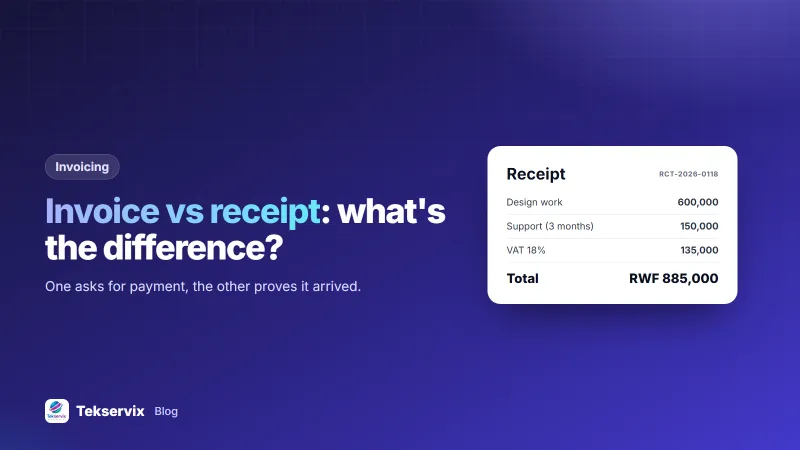
- The word "Receipt" and a unique receipt number.
- Your business name and contact details, and your tax number if you're registered.
- The customer's name (for business customers, their company name).
- Date of payment.
- What was paid for: items, or a reference to the invoice number being settled.
- Amount received and currency, with tax shown if applicable.
- Payment method: cash, bank transfer, card or mobile money, with the transaction reference.
- Balance remaining, if it was a part payment.
Always note the mobile money or bank transaction ID on the receipt. It's the fastest way to settle "I already paid" disputes months later.
When to send each: three common scenarios#
1. Services billed after the work#
A consultant finishes a project on 3 March and sends an invoice due 17 March. The client pays on the 15th. The consultant sends a receipt that references the invoice number and the bank reference. Two documents, two purposes.
2. Payment at the counter#
A customer buys a phone case and pays by mobile money on the spot. There's no invoice because nothing was owed; the customer gets a receipt. Many shops print a combined "invoice/receipt" here, which is fine as long as it clearly shows the payment.
3. Deposits and part payments#
An event planner invoices 50% up front. The client pays half; the planner issues a receipt showing the amount received and the balance still due. When the final payment arrives, a second receipt closes the invoice.
Tax rules can change the picture#
In many countries, tax authorities decide which document is the official record. In Rwanda, for example, VAT-registered businesses issue receipts through the Rwanda Revenue Authority's Electronic Billing Machine (EBM) system. Your commercial invoice is still what the customer approves and pays against, but the official tax receipt comes from the approved system. Check what applies to your registration with your accountant or tax office.
How long to keep invoices and receipts#
Keep both, for sales and purchases, for as long as your tax law requires. Several years is typical, and the period can differ by country. Digital copies are usually acceptable if they're legible and you can produce them on request. Store them by year and month, and name files consistently, for example 2026-03_INV-0042_ClientName.pdf.
Receipts for different payment methods#
What goes on the receipt changes a little with how the customer paid:
- Cash: write the amount received and, if relevant, the change given. Cash receipts are the only record, so issue one every time.
- Mobile money: record the sender's number and the transaction ID from the payment message. Customers often forward that message as "proof"; your receipt should match it exactly.
- Bank transfer: note the bank reference and the date the money actually arrived in your account, not the date the customer says they sent it.
- Card: the card terminal slip is a receipt of the card payment, but many business customers still want your own receipt with your business details and their company name.
Whatever the method, match the receipt to the money that actually arrived. If a customer pays 48,000 on an invoice for 50,000, the receipt says 48,000 received and 2,000 still due.
Common mistakes#
- Sending a receipt before payment arrives. A receipt is a statement that money was received. Sending it early can be used against you.
- Reusing invoice numbers on receipts. Keep separate sequences so each document is unique.
- Not linking them. Every receipt for an invoiced sale should quote the invoice number.
- Forgetting part payments. Show the remaining balance so nobody is surprised.
Create both in one place#
The Tekservix invoice generator makes invoices and receipts, plus tax invoices, proforma invoices, estimates and credit notes, from the same client and item lists. Totals and tax are calculated as you type, and there are 108 templates so your receipts match your invoices. If a customer asks for a quote before any of this, our guide to quote vs invoice explains where that fits.
If you're still deciding what to charge in the first place, start with our guide on how to price a product.
Frequently asked questions
Is an invoice a receipt?
No. An invoice requests payment and is sent before the customer pays. A receipt confirms that payment was received. A paid invoice marked 'PAID' can serve as proof of payment in some cases, but a separate receipt is clearer.
Do I need to give a receipt if I already sent an invoice?
It's good practice, and many customers need one for their own accounts. For cash or mobile money payments especially, a receipt protects both sides if there's a dispute later.
Can one document be both an invoice and a receipt?
Some businesses issue an 'invoice and receipt' for immediate payments at the counter. It must show that payment was received, the date, and the method. Check your tax authority's rules, because some require official receipts from approved systems.

Tekservix Team
The team behind Tekservix
The Tekservix Team builds and supports Tekservix: WhatsApp and SMS APIs, AI tools, invoicing, PDF and SEO tools for growing businesses. We write practical, tested guides based on what we see our customers do every day.
More articles from the Tekservix Team