Purchase Order Explained: What a PO Is, What It Includes and How It Works
A purchase order is the buyer's formal order to a supplier. Learn what goes on a PO, how it fits with quotes, delivery notes and invoices, and how three-way matching prevents errors.
On this page
If you sell to companies, NGOs or government bodies, you've probably heard "we can't pay without a PO number". If you buy regularly from suppliers, you may have wondered whether you should be issuing them yourself. A purchase order is a simple document, but it answers the questions that cause most buying disputes: what exactly was ordered, at what price, and who approved it.
What a purchase order is#
A purchase order (PO) is a formal document a buyer sends to a supplier, listing the goods or services they want, the quantities, the agreed prices and the delivery terms. Once the supplier accepts it, it becomes the agreement for that order.
It's the buyer's side of the conversation. The supplier's quotation says "here's what we offer"; the purchase order says "here's what we're buying".
What goes on a purchase order#
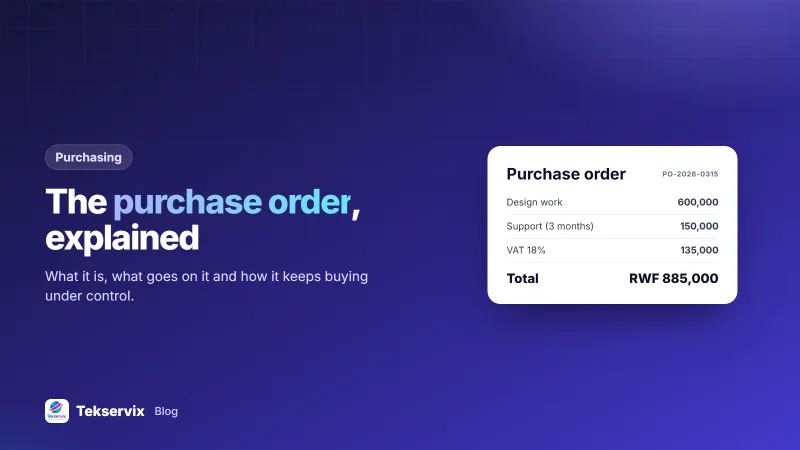
- "Purchase Order" as the title and a unique PO number, such as PO-2026-0315.
- Date of the order.
- Buyer details: company name, billing address, contact person.
- Supplier details: name, address, and their quote number if there was one.
- Line items: description, item codes, quantity, unit price and line totals.
- Taxes and total.
- Delivery: address, required date and any delivery instructions.
- Payment terms: for example "payment 30 days after invoice".
- Approval: the name and signature of the person who authorised the purchase.
How a purchase fits together#
A PO is one step in a chain of documents. In a typical business-to-business purchase:
| Step | Document | Sent by |
|---|---|---|
| 1 | Quotation | Supplier |
| 2 | Purchase order | Buyer |
| 3 | Order confirmation (optional) | Supplier |
| 4 | Delivery note | Supplier, signed by the buyer on receipt |
| 5 | Invoice, quoting the PO number | Supplier |
| 6 | Payment and receipt | Buyer pays; supplier confirms |
Three-way matching#
Before paying, a careful buyer compares three documents:
- the purchase order (what we ordered),
- the delivery note (what we received),
- the invoice (what we're being charged).
If quantities or prices don't match, the payment waits until the difference is explained. This simple check catches double invoices, short deliveries and price increases nobody agreed to. It's standard in larger organisations and easy to adopt in a small one.
Why buyers use purchase orders#
- Control spending: nothing is bought without an approved PO.
- Avoid disputes: the agreed price and quantity are written down before delivery.
- Track open orders: you can see what's been ordered but not yet delivered.
- Budgeting: committed spending is visible before the invoices arrive.
- Audit trail: donors, auditors and tax authorities can see who approved what.
Why suppliers should care#
If you sell to organisations, the PO number is often the key to getting paid. Their accounts team matches your invoice to it; an invoice without the right PO number may sit unpaid until someone chases it. When you receive a PO:
- Check it matches your quote: items, prices, quantities, delivery date.
- Raise any difference immediately, before you deliver.
- Confirm acceptance in writing.
- Put the PO number on your delivery note and invoice.
An example#
A school orders 40 desks from a furniture maker. The maker quotes Q-2026-0118. The school's bursar raises PO-2026-0315 for 40 desks at the quoted price, delivery by 15 January, payment 30 days after invoice, approved by the head teacher. The maker delivers 38 desks with a delivery note; the bursar signs for 38. The maker invoices for 40. At three-way matching, the difference shows up, the maker issues a corrected invoice for 38 and delivers the last two later against the same PO. Nobody argues, because every number is on paper.
Do small businesses need purchase orders?#
If you buy from the same suppliers often, or more than one person places orders, yes, even a simple version. It doesn't need special software: a numbered template with the fields above is enough to start. If you're a one-person business buying occasionally, a written order by email that states items, prices and delivery may be all you need. The principle is the same: agree in writing before goods move.
Changing or cancelling a PO#
Plans change. If quantities, prices or dates need to change after the supplier accepts, issue a PO amendment (for example PO-2026-0315 Rev 1) listing what changed, and ask the supplier to confirm it. To cancel, send a written cancellation quoting the PO number, before the goods ship if at all possible. Some suppliers charge for cancelled custom orders; the terms on your PO or their quote decide who bears that cost. Never change an order only by phone. The next person reading the file won't know about the call.
Blanket purchase orders#
For regular supplies, such as office consumables or a monthly delivery of packaging, a blanket PO covers repeated deliveries over a period, up to an agreed amount. Each delivery references the same PO, which saves paperwork while keeping spending under a set limit.
Creating and managing POs#
Keep purchase orders in their own numbering sequence, separate from your sales invoices. A simple word-processor or spreadsheet template with the fields above is enough to start; save each PO as a PDF before sending so it can't be changed by accident. If the order comes with drawings or specifications, combine them into one file with Merge PDF. When the supplier's invoice arrives, you'll have the PO ready to match against, and you can record the cost with your other expenses in the Business Suite. For more background on how purchase orders are used in procurement and accounting, see the Wikipedia article on purchase orders.
Many suppliers answer a purchase order with a proforma invoice, especially for international orders paid in advance.
Frequently asked questions
Is a purchase order legally binding?
Once the supplier accepts it, a purchase order generally forms a contract on the terms it states. That's why the PO should match the agreed quote and include clear terms. Local law varies, so check for large or unusual deals.
Who issues a purchase order, the buyer or the seller?
The buyer. The seller responds with an acceptance or order confirmation, delivers, and then issues an invoice that quotes the PO number.
What is the difference between a purchase order and an invoice?
A purchase order is sent by the buyer before delivery to say what they want to buy. An invoice is sent by the seller after delivery to ask for payment. The invoice should reference the PO number.

Tekservix Team
The team behind Tekservix
The Tekservix Team builds and supports Tekservix: WhatsApp and SMS APIs, AI tools, invoicing, PDF and SEO tools for growing businesses. We write practical, tested guides based on what we see our customers do every day.
More articles from the Tekservix Team