Proforma Invoice: What It Is, When You Need One and What to Include
A proforma invoice is a preliminary bill, not a demand for payment. Learn when buyers, banks and customs ask for one, what it must contain and how it differs from a quote.
On this page
An overseas buyer asks for a "proforma" before paying a deposit. Your bank wants one to process an import payment. A customs agent asks for one to estimate duties. If you've never issued a proforma invoice, it's easy to send the wrong document, or to record revenue that hasn't actually happened yet.
Here's what a proforma invoice is, when you need one, what to put on it, and how it differs from a quote and a final invoice.
What a proforma invoice is#
A proforma invoice is a preliminary bill sent before a sale is completed. It sets out exactly what will be supplied, at what price and on what terms, so the buyer can arrange payment, financing or import paperwork.
It looks like an invoice, but it isn't one in the accounting sense. It doesn't create a debt the customer must pay by a due date, and you don't record it as a sale. That comes later, with the final commercial or tax invoice.
When you'll be asked for one#
- Advance payments and deposits: the buyer needs a formal document to pay before goods are made or shipped.
- Import permits and letters of credit: banks often need a proforma to open a letter of credit or release foreign currency.
- Customs estimates: importers use it to estimate duties before the shipment arrives.
- Internal approval: a large company's purchasing department may need one to raise a purchase order.
- Donor and grant purchases: NGOs and projects often need proformas to compare suppliers.
What to include#
- The title "Proforma Invoice", clearly, so nobody mistakes it for a final invoice.
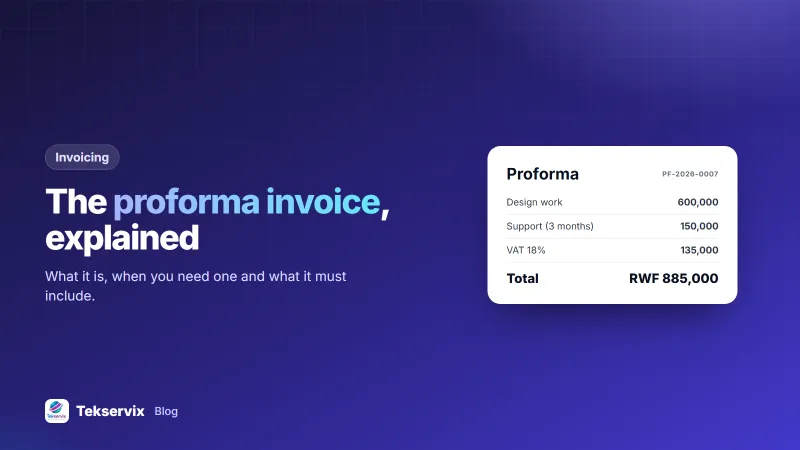
- A reference number from its own sequence (for example PF-2026-0007).
- Issue date and validity period: "valid for 30 days", because prices and exchange rates move.
- Seller and buyer details: legal names, addresses, tax numbers and contacts.
- Detailed line items: description, quantity, unit price, and for goods, weights and HS codes if customs will use it.
- Currency, taxes and total.
- Delivery terms: the Incoterm (such as EXW, FOB or CIF), place of delivery and expected shipping date.
- Payment terms: deposit percentage, balance, and bank details.
For the Incoterms, use the official definitions from the International Chamber of Commerce, so both sides agree who pays for freight and insurance.
Proforma vs quotation vs final invoice#
| Quotation | Proforma invoice | Final invoice | |
|---|---|---|---|
| Purpose | Offer a price | Formalise a proposed sale for payment or paperwork | Request payment for a completed sale |
| Detail | Often summary | Full invoice detail, shipping and payment terms | Full detail, tax-compliant |
| Recorded as revenue? | No | No | Yes |
| Who uses it | Customer | Customer, bank, customs | Customer, accountant, tax authority |
Our guide to quote vs invoice covers the simpler, domestic side of this comparison.
A worked example#
A coffee roaster in Rwanda agrees to ship 500 kg to a buyer abroad, 40% up front. The roaster sends a proforma invoice: 500 kg at the agreed price per kg, FOB terms, shipping in three weeks, a 30-day validity, and bank details. The buyer's bank uses it to send the deposit. When the coffee ships, the roaster issues the final commercial invoice for the full amount, shows the deposit already received, and states the balance due. The proforma number is referenced on the final invoice, so everyone can trace the deal.
Common mistakes#
- Calling it an invoice. Without "Proforma" in the title, a customer's accountant may record a debt that doesn't exist yet.
- No validity date. A price quoted in March shouldn't bind you in August.
- Vague descriptions. Customs and banks reject documents that don't match the goods.
- Forgetting to issue the final invoice. The proforma never replaces it.
- Mixing numbering sequences. Keep proformas separate from invoices.
Exchange rates and validity#
International proformas are often quoted in a foreign currency while your costs are local. Two lines protect you:
- State the currency explicitly ("All prices in USD") and, if you quote in local currency for a foreign buyer, add "subject to exchange rate on the date of payment".
- Keep validity short when prices are volatile: 15 or 30 days is common. After it expires, issue a new proforma with a new number rather than editing the old one.
If the buyer's bank asks for changes, such as a different consignee name or port, issue a revised proforma marked "Revision 1" so there's always one current version.
What happens after the customer pays#
A proforma is a promise, not a record of a sale, so the paperwork isn't finished when the money arrives. Once the customer pays, issue a proper invoice (or a receipt, if payment came first) with its own number from your invoice sequence. Reference the proforma number on it, for example "Ref: PF-2026-0007", so anyone checking can follow the trail.
If the final amount differs from the proforma, because a quantity changed or the exchange rate moved, the invoice shows the real figures. Don't edit the proforma after the fact to match. Keep both documents on file: the proforma shows what was offered, and the invoice shows what was actually sold. Your accountant and, if it comes to it, the tax authority will want to see the invoice, not the proforma.
Creating a proforma in minutes#
In the Tekservix invoice generator, start a new document, set the title to "Proforma Invoice" and use a PF- number prefix. Add your logo, line items, currency, shipping and payment terms. Totals and taxes calculate as you type. Once the deal completes, create the final invoice from the same client and items. If the deal involves a formal order from the buyer, our guide to the purchase order explains how that document fits in, and invoicing in a foreign currency covers exchange-rate details.
If you're unsure what figures to put on it, start with how to price a product. Once the goods ship, our guide on how to write an invoice covers the final bill.
Frequently asked questions
Is a proforma invoice a legal invoice?
No. A proforma invoice is a preliminary document that describes a proposed sale. It isn't a request for payment in the accounting sense and usually isn't recorded as revenue. The final commercial or tax invoice is issued once the sale happens.
Can a customer pay against a proforma invoice?
Yes, it's common for advance payments and deposits, especially in international trade. When the payment arrives and the goods ship, issue a final invoice that references the proforma.
What is the difference between a proforma invoice and a quotation?
Both state a price before the sale. A proforma invoice is more formal and detailed, with the full invoice layout, shipping terms and often weights and HS codes, because it is used by banks and customs. A quotation is usually simpler and for the customer's decision only.

Tekservix Team
The team behind Tekservix
The Tekservix Team builds and supports Tekservix: WhatsApp and SMS APIs, AI tools, invoicing, PDF and SEO tools for growing businesses. We write practical, tested guides based on what we see our customers do every day.
More articles from the Tekservix Team