How to Write an Invoice: What to Include, With an Example
The 12 things every invoice needs, how to number invoices, which payment terms to choose, a complete example, and the mistakes that delay payment.
On this page
- What is an invoice?
- What to include on an invoice: the checklist
- How to write an invoice, step by step
- 1. Put your details and branding at the top
- 2. Give it a number that never repeats
- 3. Add the client's details and their reference
- 4. Write line items someone else can understand
- 5. Show the totals clearly
- 6. Set a due date and payment terms
- 7. Make paying easy
- 8. Send it as a PDF
- A complete invoice example
- Invoices and tax rules
- Mistakes that delay payment
- How to get paid faster
- Create your invoice in a few minutes
A vague invoice gets paid late. When a client's accounts team can't match your invoice to an order, can't see the due date, or doesn't know how to pay, it goes to the bottom of the pile. A clear one gets approved on the first read.
Here's how to write an invoice that gets paid: exactly what to include, how to number it, which payment terms to choose, a complete example, and the mistakes that cause most payment delays.
What is an invoice?#
An invoice is a dated document a seller sends to a buyer that lists the goods or services supplied, the amount owed, and how and when to pay. It is the buyer's record of a purchase and the seller's record of income, which is why tax authorities care about it too.
It is not the same as a quote or a receipt:
- Quote (estimate): sent before the work, with a proposed price.
- Invoice: sent after delivery, or at an agreed milestone, requesting payment.
- Receipt: sent after payment, confirming the money arrived.
What to include on an invoice: the checklist#
Every professional invoice should contain these 12 items:
- The word "Invoice" at the top (or "Tax invoice" where your tax rules require it).
- A unique invoice number.
- The invoice date.
- The due date, not just the payment terms.
- Your business name, address and contact details, plus your logo.
- Your tax or VAT number, if you're registered.
- The client's name and billing address, and their tax number for business clients where required.
- The client's purchase order (PO) number, if they gave you one.
- Line items: description, quantity, unit price and line total.
- Subtotal, discounts, tax and the total due, in one clearly stated currency.
- Payment instructions: bank details, mobile money number or payment link.
- A short note: thanks, late-payment terms or a reference to quote when paying.
How to write an invoice, step by step#
1. Put your details and branding at the top#
Your logo, business name, address, email and phone go in the header. Clients, and their finance teams, should know who sent it in one glance.
2. Give it a number that never repeats#
Invoice numbers must be unique and should run in order. Two simple systems work well:
- Sequential with a year: INV-2026-0001, INV-2026-0002, and so on.
- Per client: ACME-017, useful when you invoice a few large clients often.
Never reuse or skip numbers to "tidy up". Gaps raise questions in an audit. If an invoice is wrong, cancel it with a credit note and issue a new one.
3. Add the client's details and their reference#
Use the client's legal business name, not a contact person's first name. If they sent a purchase order, put the PO number on the invoice. Many companies can't approve a payment without it, and this single field causes more delays than anything else.
4. Write line items someone else can understand#
The person approving your invoice often wasn't in the meetings. Write each line so they can recognise the work:
- Weak: "Design work: 1,200,000"
- Better: "Website homepage design, 3 revision rounds (15 to 29 Sept): 1 × 1,200,000"
For time-based work, show hours and rate. For products, show quantity and unit price.
5. Show the totals clearly#
List the subtotal, then any discount, then tax, then the total due in bold. State the currency once, clearly, for example "All amounts in RWF" or "USD". If you work across borders, never leave the currency to guesswork.
6. Set a due date and payment terms#
Write the actual due date, such as "Due 30 October 2026", as well as the terms. Common terms:
| Term | Meaning | Good for |
|---|---|---|
| Due on receipt | Pay immediately | Small one-off jobs, new clients |
| Net 7 / Net 15 | Pay within 7 or 15 days | Freelancers, small businesses |
| Net 30 | Pay within 30 days | Larger companies with monthly payment runs |
| 50% upfront | Deposit before work, balance on delivery | Projects with material costs or long timelines |
Shorter terms get paid faster, but large clients often pay on fixed monthly cycles whatever you write. Ask about their payment run when you agree the job.
7. Make paying easy#
Put every payment option on the invoice: bank name, account name and number, SWIFT code for international clients, and your mobile money number if clients use it. Ask them to quote the invoice number as the payment reference, so you can match the money to the invoice.
8. Send it as a PDF#
Send a PDF, not an editable document, so the numbers can't be changed by accident. Keep the file small. If your invoice PDF is several megabytes, the logo is probably oversized; our guide to compressing a PDF without losing quality explains why and how to fix it.
A complete invoice example#
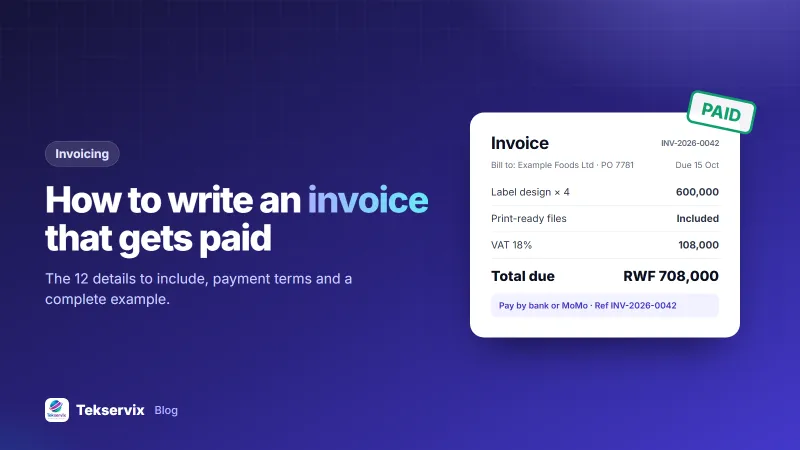
| Invoice INV-2026-0042 | |
|---|---|
| From | Example Design Studio Ltd, KG 7 Ave, Kigali · hello@studio.example · TIN 123456789 |
| Bill to | Example Foods Ltd, Finance Department · PO 7781 |
| Invoice date | 30 September 2026 |
| Due date | 15 October 2026 (Net 15) |
| Product label design, 4 flavours × 150,000 | 600,000 |
| Print-ready files and 2 revision rounds | Included |
| Subtotal | 600,000 |
| VAT 18% | 108,000 |
| Total due (RWF) | 708,000 |
| Pay to | Your bank, Example Design Studio Ltd, account 000-000000-00 · or MoMo 078 000 0000. Reference: INV-2026-0042 |
The business names and numbers above are examples. Notice what a finance clerk sees: who sent it, their PO number, the due date, the tax, the total and exactly how to pay.
Invoices and tax rules#
Tax authorities set rules for what counts as a valid tax invoice, and they differ by country. VAT-registered sellers usually must show their VAT or tax number, the tax rate and the tax amount. Some countries go further. In Rwanda, for example, VAT-registered businesses issue receipts through the Rwanda Revenue Authority's Electronic Billing Machine (EBM) system.
A well-designed invoice is still the document your client approves and pays against. Just check with your tax authority or accountant which official receipts or e-invoicing steps apply to your business alongside it.
Mistakes that delay payment#
- No due date, only "payment terms apply".
- Missing PO number for corporate clients.
- Sending to the wrong person. Ask for the accounts payable email, not just your project contact's.
- Unclear currency on cross-border work.
- Arithmetic errors. One wrong total and the whole invoice comes back.
- Waiting to invoice. Invoice the day the work is delivered, while the value is fresh.
How to get paid faster#
- Send a polite reminder three days before the due date, and another the day after.
- Offer a payment link or mobile money, not just bank transfer.
- Take a deposit on larger projects.
- Remind by message, not just email. A short WhatsApp or SMS reminder is read within minutes. Our guides to the WhatsApp API and an Android SMS gateway show how to automate those reminders.
Create your invoice in a few minutes#
You can build every part of this checklist in the Tekservix invoice generator. Choose one of 108 templates (12 layouts in 9 colour palettes), add your logo, and totals, discounts and tax are calculated as you type. The same tool makes quotes, receipts, purchase orders, credit notes and delivery notes, and remembers your clients and items for next time.
Creating and previewing invoices is free. Downloading, printing and sending a private link your client can open are included with a Tekservix plan.
Frequently asked questions
What should an invoice include?
An invoice number, invoice date, due date, your business details and tax number, the client's details and PO number, line items with quantities and prices, subtotal, tax, total due in a stated currency, and payment instructions.
How do I number my invoices?
Use a unique, sequential number that never repeats, such as INV-2026-0001, INV-2026-0002. Don't reuse or skip numbers; correct a wrong invoice with a credit note and issue a new one.
What is the difference between an invoice and a receipt?
An invoice asks for payment and is sent after the work or delivery. A receipt confirms that payment has been received and is sent after the client pays.

Tekservix Team
The team behind Tekservix
The Tekservix Team builds and supports Tekservix: WhatsApp and SMS APIs, AI tools, invoicing, PDF and SEO tools for growing businesses. We write practical, tested guides based on what we see our customers do every day.
More articles from the Tekservix Team