Freelance Contract: What to Include to Protect Your Work and Get Paid
The clauses every freelance contract needs: scope, deliverables, revisions, payment terms, deposits, late fees, ownership, confidentiality and ending the project, with plain-language examples.
On this page
Most freelance disputes follow a familiar script. The client asks for "just one more change", the project grows, the invoice is questioned, and payment arrives late or not at all. A clear freelance contract doesn't prevent every problem, but it turns arguments into a quick look at what was agreed. It also signals that you run a professional business, which good clients appreciate.
This guide goes through the clauses to include, with plain-language examples you can adapt. It isn't legal advice; for large or unusual projects, have a lawyer review your template once.
1. Parties and project summary#
Names, business names, addresses and contacts for both sides, the date, and one or two sentences describing the project: "Design of a logo and brand kit for [Client]'s new bakery."
2. Scope and deliverables#
The most important clause. List exactly what you'll deliver:
Deliverables: 3 initial logo concepts; 1 chosen concept developed into a final logo in colour, black and white versions; files in PNG, SVG and PDF; a one-page brand guide with colours and fonts.
Then list what's not included: "Not included: website design, printing, social media templates." Exclusions prevent the slow growth of a project into something twice the size at the same price.
3. Revisions#
Unlimited revisions are the single most common cause of unprofitable freelance work. Set a number and a price for more:
Includes two rounds of revisions on the chosen concept. Further revisions are billed at RWF 25,000 per round.
Define what a "round" is: one consolidated list of changes from the client, not a stream of messages over a week.
4. Timeline and client responsibilities#
Give dates for each stage, and make them depend on what the client provides: "First concepts within 7 working days of receiving the deposit and the completed brief." If feedback takes three weeks, the deadline moves by three weeks. Say so in writing.
5. Fees and payment terms#
- Total fee or rate (hourly, daily or fixed).
- Deposit: 30 to 50% before work starts is common, and non-refundable once work has begun.
- Milestones: for longer projects, payment at each stage.
- Due dates: for example 7 or 14 days from invoice. See payment terms explained.
- How to pay: bank, mobile money, card link.
- Currency and who pays transfer fees.
- Expenses: stock photos, fonts, travel, and whether they're billed at cost.
6. Late payment#
Invoices unpaid 14 days after the due date incur a late fee of 2% per month. Work may be paused while payments are overdue, and final files are released on full payment.
Check that late fees are allowed and at what level in your country. Holding final files until payment is often the most effective clause in practice.
7. Ownership and licence#
Say who owns the finished work and when:
On receipt of full payment, [Client] owns the final logo files. The freelancer keeps ownership of unused concepts and may show the final work in their portfolio unless the client asks otherwise in writing.
If you use fonts, photos or code libraries with their own licences, note that those licences still apply.
8. Confidentiality#
A short clause that both sides keep each other's business information private. For sensitive projects, a separate non-disclosure agreement may be appropriate.
9. Cancellation and termination#
- Either party can end the agreement with written notice.
- The client pays for work done up to that point; the deposit covers early-stage work.
- Files delivered on cancellation are those paid for.
10. Liability and disputes#
Limit your liability to the fees paid under the contract, state which country's law applies, and how disputes are handled: discussion first, then mediation, then courts. Keep it simple; the point is that there's a path.
11. Signatures#
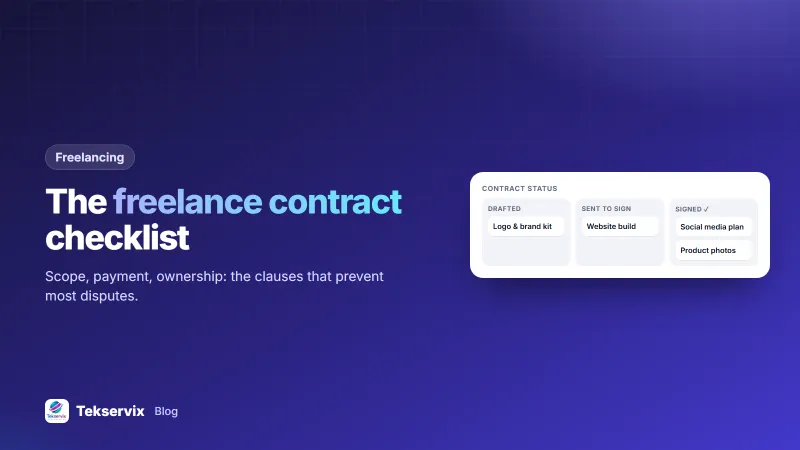
Both parties sign and date. Electronic signatures are widely accepted for this kind of agreement and are far faster than printing and scanning. Our guide to electronic signatures explains when they're legally valid.
A worked example#
Imagine a web designer who agrees to "build a website" for a client. Without a contract, the client later expects copywriting, a booking system and monthly updates. With a contract listing five pages, a contact form, two revision rounds and a 40% deposit, the designer can say: "Happy to add a booking system; here's a separate quote." The relationship survives, and the extra work is paid.
Making contracts quick#
Build one template with these clauses, and fill in the specifics for each client. The Tekservix Business Suite lets you prepare the contract, send the client a private link to e-sign it, and follow up with a deposit invoice from the same place. For freelancers setting up their paperwork, our guide to the freelance invoice covers the billing side. Background on freelancing rights in some countries is available from official sources, for example the UK government's guide to working for yourself.
Before a contract, most clients want a price in writing; our guide on how to write a quotation covers that first step.
Frequently asked questions
Do freelancers really need a contract for small jobs?
Yes, even a one-page agreement. Most freelance disputes are about scope and payment, and a short written agreement that both sides accepted settles them quickly. For very small jobs, a detailed accepted quote can serve the same purpose.
Is an electronically signed freelance contract valid?
In many countries, yes, provided both parties clearly agreed to it and you can show who signed and when. Check your local e-signature law for specific requirements.
Who owns the work in a freelance project?
It depends on the contract and local law. Many contracts transfer ownership to the client once they've paid in full, while the freelancer keeps the right to show the work in a portfolio. Write it down either way.

Tekservix Team
The team behind Tekservix
The Tekservix Team builds and supports Tekservix: WhatsApp and SMS APIs, AI tools, invoicing, PDF and SEO tools for growing businesses. We write practical, tested guides based on what we see our customers do every day.
More articles from the Tekservix Team