How to Write a Quotation: Step-by-Step Guide With a Sample
How to write a quotation customers can say yes to: the sections to include, how to describe scope and exclusions, pricing options, validity, terms and a sample you can adapt.
On this page
- Before you write: get the brief right
- The sections of a quotation
- 1. Header
- 2. Customer details
- 3. A one-line summary
- 4. Line items
- 5. Scope and exclusions
- 6. Totals and taxes
- 7. Validity
- 8. Payment and delivery terms
- 9. How to accept
- Give options, not just a price
- Sample quotation
- Wording that builds trust
- Mistakes to avoid
- After you send it
- Make quotes in minutes
A quotation is often the first document a customer receives from you, and it does more selling than you might think. Two suppliers can offer the same work at the same price, and the one whose quote is clearer, better organised and easier to accept usually wins. Knowing how to write a quotation well is a skill that pays for itself on every job.
This guide walks through each section, with wording you can borrow and a complete sample at the end.
Before you write: get the brief right#
Most bad quotes come from a vague request. Before pricing, confirm:
- What exactly the customer wants, in their words.
- Quantities, sizes, locations and deadlines.
- What they'll provide themselves, such as content, materials or access.
- Their budget range, if they'll share it.
- Who approves the purchase.
Five minutes of questions saves a round of revisions and a price you regret.
The sections of a quotation#
1. Header#
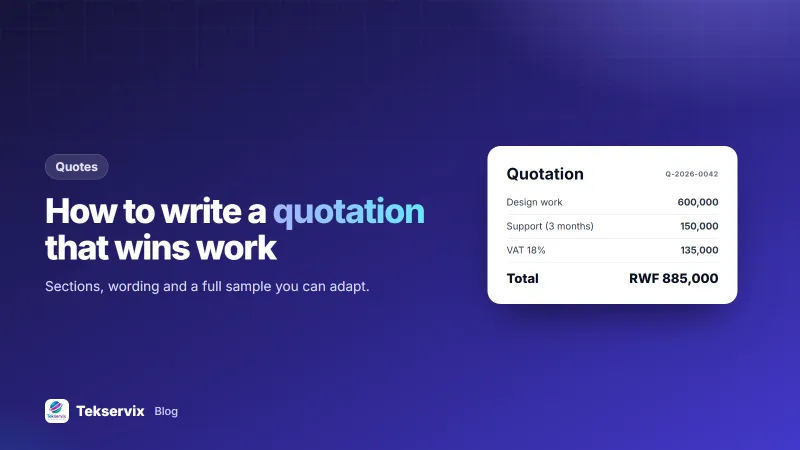
Your business name, logo, address, phone, email and tax number if you're registered. Then the title "Quotation", a quote number from its own sequence (for example Q-2026-0042) and the date.
2. Customer details#
The customer's organisation, contact person and address. For companies, use the legal name that will appear on the invoice.
3. A one-line summary#
Say what the quote is for in plain words: "Supply and installation of 12 office chairs at your Kacyiru office." It tells a busy reader, or their manager, what they're looking at.
4. Line items#
Each line should have a description, quantity, unit price and line total. Write descriptions the customer would recognise: "Ergonomic office chair, black mesh, adjustable arms" beats "Item 7731".
5. Scope and exclusions#
This is the section that prevents arguments. List what's included and, just as importantly, what isn't:
Included: delivery to one address in Kigali, assembly, removal of packaging.
Not included: disposal of old chairs, work outside business hours.
6. Totals and taxes#
Show the subtotal, any discount, tax and the grand total, with the currency. If prices exclude tax, say so clearly next to the total.
7. Validity#
"This quotation is valid for 30 days from the date above." Without it, a customer can accept an old price after your costs have risen.
8. Payment and delivery terms#
Deposit, balance and how to pay. Expected start or delivery date after acceptance. For example: "50% deposit on acceptance, balance on delivery. Delivery within 10 working days of deposit."
9. How to accept#
Make saying yes easy: "To accept, sign below and return, or click Accept on the online quote." The fewer steps, the faster you get the go-ahead.
Give options, not just a price#
When the job allows it, offer two or three versions: a basic option, the one you recommend, and a complete one. Customers then compare your options rather than comparing you against another supplier. Label the recommended option clearly and explain in one line what the extra money buys. Our article on how to price a product covers how to set each level.
Sample quotation#
| Description | Qty | Unit price (RWF) | Total (RWF) |
|---|---|---|---|
| Ergonomic office chair, black mesh, adjustable arms | 12 | 145,000 | 1,740,000 |
| Delivery and assembly, Kacyiru office | 1 | 60,000 | 60,000 |
| Subtotal | 1,800,000 | ||
| VAT 18% | 324,000 | ||
| Total | 2,124,000 | ||
Quotation Q-2026-0042, dated 8 October 2026, valid for 30 days. Included: delivery to one address and assembly. Not included: disposal of old furniture. Terms: 50% deposit on acceptance, balance on delivery within 10 working days. Warranty: 2 years on frames and mechanisms.
The figures are an illustration; use your own prices and the tax rate that applies to your business.
Wording that builds trust#
- Be specific about time: "within 10 working days of deposit" is better than "soon".
- Mention guarantees and after-sales support if you offer them.
- Add a short note above the items if helpful: "Following our call on Monday, here's the quote for the chairs we discussed."
- Keep the tone plain. A quote isn't the place for marketing slogans.
Mistakes to avoid#
- Lumping everything into one line with one price. Customers can't see what they're paying for.
- Forgetting exclusions, and then doing unpaid extra work to keep the peace.
- No validity date.
- Sending it days late. Speed signals reliability; aim to quote within one working day.
- Sending a Word file the customer can edit. Send a PDF or an online link.
After you send it#
Many quotes are lost simply because nobody follows up. Send a short, friendly message three days later ("Did you have any questions about the quote?") and another a week after that. Our guide to customer follow-up has message templates. Track each quote as a deal so you know which ones are waiting; sales pipeline stages explains a simple way to do that.
When the customer accepts, turn the quote into an invoice without retyping it. The difference between the two documents is covered in quote vs invoice.
Make quotes in minutes#
In the Tekservix Business Suite, you build a quote from saved customers and items, send the customer a private link, and they accept or decline online. Accepted quotes convert to invoices in one click. If you trade internationally, the ICC's Incoterms rules help you state delivery terms precisely.
Frequently asked questions
What should a quotation include?
Your details and the customer's, a quote number and date, a clear description of the work or goods with quantities and prices, what's excluded, taxes and total, a validity date, payment terms and how to accept.
How long should a quotation be valid?
Commonly 14 to 30 days. Use a shorter period when your costs change quickly, such as imported materials or fuel-dependent jobs, and a longer one for stable services.
Should I offer more than one price in a quotation?
Offering two or three options, such as basic, standard and complete, often works well because the customer chooses between your options rather than between you and a competitor. Keep it to three at most.

Tekservix Team
The team behind Tekservix
The Tekservix Team builds and supports Tekservix: WhatsApp and SMS APIs, AI tools, invoicing, PDF and SEO tools for growing businesses. We write practical, tested guides based on what we see our customers do every day.
More articles from the Tekservix Team