Sales Pipeline Stages: A Simple 6-Stage Model for Small Businesses
The six sales pipeline stages most small businesses need, what moves a deal from one to the next, and the numbers that tell you where deals are getting stuck.
On this page
Ask a small business owner how many deals they have in progress and you'll often get a pause, then a guess. The deals are there, spread across WhatsApp chats, email threads and a notebook, but nobody can see them in one place. Defining your sales pipeline stages fixes that. Each deal gets a clear position, and you can see at a glance what needs a push today.
This guide gives you a six-stage model that works for most service and product businesses, the rule that moves a deal from each stage to the next, and the few numbers worth tracking.
What a sales pipeline is#
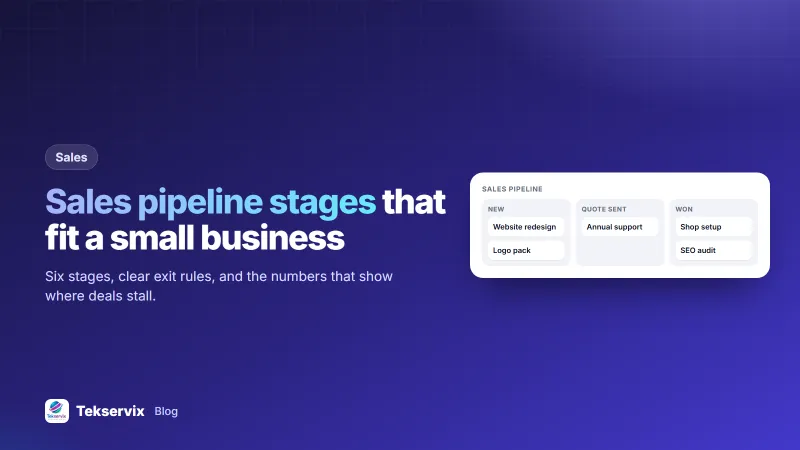
A sales pipeline is a visual list of every open deal, grouped by how close it is to being won. Deals move left to right as the customer takes each step, until they're won or lost. The value of the pipeline isn't the drawing. It's the discipline of asking "what is the next step on this deal, and who does it?" for every opportunity you have.
A pipeline is different from a list of contacts. Someone who follows you on Instagram is a contact. They become a deal when there's a specific need, a rough value and a next step.
The six stages#
1. New lead#
Someone has shown interest: filled a form, sent a WhatsApp message, asked for a price at a trade fair. You know who they are and roughly what they want, and nothing more.
Moves on when: you've had a real conversation and confirmed they have a need you can meet.
2. Qualified#
You've spoken and the fit is real. A simple way to qualify is to confirm four things: the need is genuine, there's a budget in the right range, the person you're talking to can decide or knows who does, and there's a rough timeframe.
Moves on when: you've agreed to send a proposal or quotation.
3. Proposal sent#
The customer has your quote, proposal or price list with the specifics filled in. This is where many deals quietly die, because nobody follows up.
Moves on when: the customer responds with questions, changes or a request to negotiate.
4. Negotiation#
You're discussing scope, price, delivery dates or payment terms. Keep a record of what was offered at each round, so nobody promises a discount that was already given.
Moves on when: both sides agree on the final terms.
5. Won#
The customer accepted the quote, signed the contract or paid the deposit. Winning isn't the end: this is where you hand over to delivery and send the invoice.
6. Lost#
Always record lost deals, with a reason. "Too expensive", "chose a competitor", "project cancelled" and "no response" each tell you something different about your business.
Why exit rules matter more than stage names#
The names above are common, but you can call the stages anything. What matters is that each stage has a rule everyone agrees on. Without one, a salesperson who had a nice chat moves a deal to "Negotiation" and the pipeline starts to lie. The test is simple: could someone else look at the deal and agree it belongs in that stage, based on something the customer did? Stages should reflect customer actions, not your hopes.
A worked example#
A printing company in Kigali gets a WhatsApp message from a school asking about printed report books. The deal enters New lead. On a call the next day, the bursar confirms 600 books are needed before the end of term and there's budget: the deal moves to Qualified with a value of about RWF 1.8 million. The printer sends a quotation that afternoon: Proposal sent. A week later the school asks whether the price drops for 800 books: Negotiation. The printer offers a lower unit price for 800 with a 50% deposit, the school accepts the quote online, and the deal is Won. Every step had a date and a next action, so nothing waited on someone's memory.
Numbers worth tracking#
| Number | What it tells you |
|---|---|
| Deals per stage | Where work is piling up |
| Stage-to-stage conversion | Which step loses the most deals |
| Average days in each stage | Where deals stall |
| Win rate | Won deals divided by won plus lost |
| Pipeline value | The total value of open deals, ideally weighted by stage |
Weighted value is a rough forecast. If historically half of your negotiated deals close, a RWF 2 million deal in Negotiation counts as RWF 1 million. It's an estimate, not a promise, but it's far better than guessing next month's revenue.
Diagnosing a pipeline that stalls#
- Lots of leads, few qualified: your marketing attracts the wrong people, or your first reply is too slow. Answer new enquiries within an hour where you can.
- Many proposals, few replies: you're not following up. Two polite follow-ups, three and seven days after sending, recover a surprising share of these.
- Long negotiations: the proposal was unclear or the decision-maker wasn't involved early. Ask at qualification who else needs to approve.
- Most losses on price: either you're targeting the wrong customers or not explaining your value. Our guide to pricing a product covers both sides.
Keep the pipeline clean#
A pipeline full of old deals is worse than no pipeline, because it makes you feel busy. Once a week, look at every deal that hasn't moved in 30 days. Either set a next step with a date or mark it lost with the reason "no response". You can always reopen it if they come back.
Every open deal should have a next action and a date. If it doesn't, it isn't really being worked.
B2B and B2C pipelines look different#
A business selling to other businesses usually has longer stages, more people involved in the decision and bigger deals, so every stage matters. A shop selling to consumers often skips qualification entirely: someone asks a price on WhatsApp, you answer, they buy or they don't. In that case a three-stage pipeline (enquiry, quoted, won or lost) is enough, and the most useful number is how quickly you reply.
Setting it up#
You can start with a spreadsheet: one row per deal, columns for stage, value, next step and date. It breaks down once several people share it or you have more than about 30 open deals. The CRM in the Tekservix Business Suite gives you a drag-and-drop pipeline board, and a won deal flows straight into a quote, contract and invoice without retyping. If you're choosing a system, our guide to CRM for small business lists the features that matter, and customer follow-up covers the messages that keep deals moving. For a deeper background on forecasting, Salesforce's pipeline overview is a useful read.
Frequently asked questions
How many stages should a sales pipeline have?
Most small businesses do well with five to seven. Fewer than five hides where deals stall; more than seven means people spend time deciding which stage a deal belongs in instead of selling.
What is the difference between a sales pipeline and a sales funnel?
A pipeline tracks individual deals and the actions your team takes on each one. A funnel describes how many prospects drop off between stages in total. The pipeline is the working view; the funnel is the summary.
How often should I review my sales pipeline?
Weekly for the whole team, and daily for whoever owns the deals. The weekly review should focus on deals that haven't moved since the last one.

Tekservix Team
The team behind Tekservix
The Tekservix Team builds and supports Tekservix: WhatsApp and SMS APIs, AI tools, invoicing, PDF and SEO tools for growing businesses. We write practical, tested guides based on what we see our customers do every day.
More articles from the Tekservix Team