AI Product Description Generator: How to Get Copy That Actually Sells
How an AI product description generator works, what to feed it, how to edit the output, and a worked example turning a plain product into a listing that converts.
On this page
Writing product descriptions is the job every shop owner postpones. With 200 products and a supplier's one-line spec for each, it's tempting to paste the same sentence everywhere. An AI product description generator changes the maths: a solid first draft in seconds. But only if you give it the right inputs and edit what comes out.
Here's how to get descriptions that read well, rank and sell, with a worked example.
What a product description has to do#
A good description answers the buyer's questions before they ask them:
- What is it, and who is it for?
- Why is it better than the similar item one click away?
- Will it fit, work or last? Sizes, materials, compatibility, care.
- What happens after I buy? Delivery, returns, guarantee.
AI is good at structure and phrasing. It can't know your materials, your sizing quirks or why your version is better unless you tell it.
What to feed the generator#
The Tekservix Product Description Generator works from a product name and a few details. The quality of those details decides the quality of the output. Give it:
- Product name and category.
- The buyer: "busy parents", "office workers", "first-time campers".
- 3 to 5 concrete features: materials, dimensions, capacity, battery life.
- The main benefit: what problem it solves in their day.
- Proof: handmade, locally sourced, warranty, certification.
- Tone: luxury, playful, technical or friendly.
The generator returns benefit-led copy with bullet points, plus SEO keywords, a meta title and a meta description for the product page.
A worked example#
Supplier's line: "Leather sandal, brown, sizes 36-45."
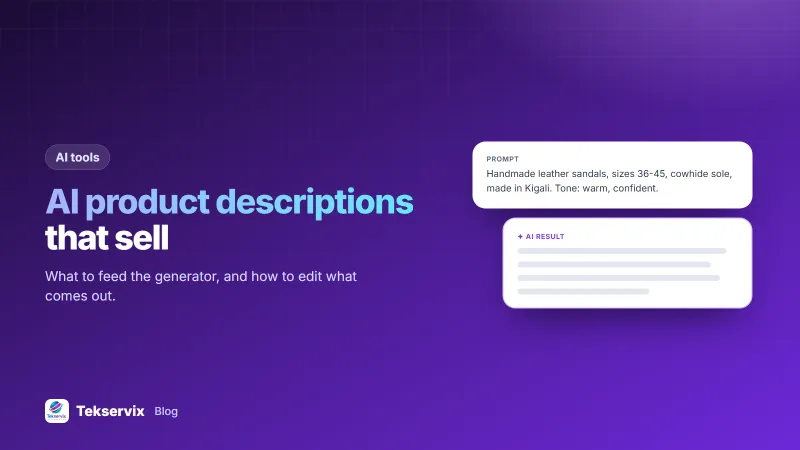
Input we gave the generator: handmade leather sandals; for people who walk a lot in the city; full-grain cowhide upper, stitched rubber sole, adjustable buckle; sizes 36 to 45; made in Kigali; tone warm and confident.
Edited result:
Made for long days on your feet. These handmade sandals pair a full-grain cowhide upper with a stitched rubber sole that grips on wet pavement and doesn't peel after a season. The adjustable buckle means a snug fit whether your feet swell by evening or not.
- Full-grain cowhide, softens as you wear it
- Stitched, not glued, rubber sole
- Adjustable buckle strap
- Sizes 36 to 45 (true to size; between sizes, go up)
- Handmade in Kigali
Notice the edits: a sizing tip only the shop knows, the claim "doesn't peel" backed by the stitched sole, and no vague words like "premium quality".
How to edit AI output (5 minutes per product)#
- Check every fact. Delete anything the product doesn't actually have. AI sometimes fills gaps with plausible features.
- Replace vague adjectives ("high-quality", "stylish") with specifics.
- Add one thing only you know: fit advice, a customer comment, a care tip.
- Front-load the key benefit in the first sentence; many shoppers read nothing else.
- Keep it scannable: short paragraph, then bullets.
Our guide to making AI writing sound human has more editing techniques, and how to write product descriptions covers the craft without AI.
SEO for product pages#
- Unique text on every product. Copying the manufacturer's description, or reusing one template across 50 items, creates duplicate content that rarely ranks.
- Use the words shoppers search: "leather sandals for men" rather than "gentleman's leather footwear".
- Write the meta title and description for each important product. The generator suggests both.
- Add alt text to product photos describing the item.
- Mark up products with structured data (price, availability) so Google can show rich results, as described in Google's product structured data guide.
Different platforms, different lengths#
| Where | What works |
|---|---|
| Your own online shop | A short opening paragraph, 4 to 6 bullets, then details like care and sizing further down |
| Marketplaces | Follow their title and bullet rules exactly; put the most searched feature in the title |
| WhatsApp catalogue | Two or three lines: what it is, the key benefit, the price. People read it on a phone |
| Social posts | One hook sentence and one clear call to action; save the specs for the product page |
Generate one strong master description, then ask for shorter versions for each channel. The marketing copy tool produces platform-ready variants for Instagram, Facebook and ads from the same product details.
Mistakes to avoid#
- Invented specifications. If the draft says "waterproof" and it isn't, you'll pay for it in returns.
- Keyword stuffing: repeating "leather sandals" six times reads badly and doesn't help rankings.
- Identical tone for every product. A children's toy and a laptop bag shouldn't sound the same.
- Forgetting the price context: if it's more expensive than alternatives, the description must say why.
Measure whether the new descriptions sell#
Rewriting descriptions is work, so check that it pays. Pick 20 products with steady traffic, replace their descriptions, and leave 20 similar products unchanged as a comparison. After four weeks, compare the two groups on three numbers: the share of visitors who add to cart, the conversion rate, and the number of pre-sale questions customers ask about those products.
Fewer "does it come in blue?" or "what size is it?" messages is a good sign in itself, because it means the page is answering the questions before they are asked. If the rewritten group does better, roll the approach out to the rest of the catalogue, starting with your best sellers.
Working at scale#
For a catalogue of hundreds, don't generate everything in one sitting. Start with your 20 best-sellers, where better copy pays back fastest. Then work through the rest by category, reusing the buyer and tone settings for similar products while changing the features. Good photos matter as much as words; our guide to white-background product photos covers the image side.
If you worry a description will be flagged as AI-written, read how accurate AI detectors really are. Shoppers and search engines care far more about whether the text is specific and true.
Frequently asked questions
Are AI-generated product descriptions good for SEO?
They can be, if each description is unique, accurate and useful to shoppers. Avoid pasting the same generic text across many products, and add real details like materials, sizes and use cases that only you know.
What information should I give an AI product description generator?
The product name, who it's for, its key features, materials or specifications, what problem it solves, and the tone you want. The more specific the input, the better the output.
Can I use AI product descriptions on Amazon, Shopify or Etsy?
Yes. Adjust the length and format to each platform's rules, check every factual claim, and make sure the description matches the product exactly.

Tekservix Team
The team behind Tekservix
The Tekservix Team builds and supports Tekservix: WhatsApp and SMS APIs, AI tools, invoicing, PDF and SEO tools for growing businesses. We write practical, tested guides based on what we see our customers do every day.
More articles from the Tekservix Team