AI Copywriting: A Practical Guide to Ads, Posts and Emails That Don't Sound Robotic
How to use AI copywriting well: write a proper brief, pick an angle, generate variants to test, edit for voice and facts, and know which jobs still need a human writer.
On this page
A small business needs a lot of words: Instagram captions, Facebook ads, promotional SMS, email newsletters, Google Ads headlines, product pages. AI copywriting tools can draft all of these in seconds. The trouble is that most AI copy reads the same: "Unlock your potential with our innovative solution." Customers scroll straight past it.
The difference between forgettable AI copy and copy that sells is mostly in what you give the tool and what you do with the draft. This guide covers both.
What AI is good at, and what it isn't#
| AI does well | You still need to |
|---|---|
| Producing many variations quickly | Choose which angle fits your customer |
| Adapting length and format to each platform | Add specifics only you know: prices, places, results |
| Getting past the blank page | Check every claim is true |
| Rewriting in a different tone | Keep the voice consistent with your brand |
Step 1: Write a real brief#
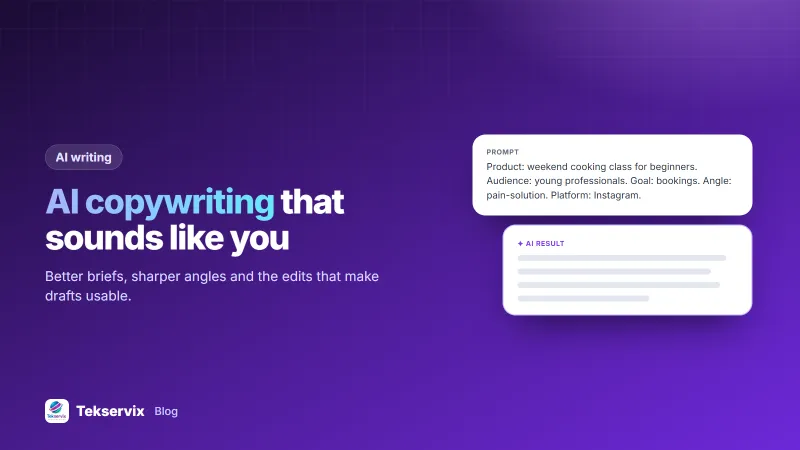
A tool given "write an ad for my cooking class" produces the average of every cooking class ad it has seen. Give it what makes yours different:
- Product: Saturday cooking class, 3 hours, 8 people maximum, learn five Rwandan dishes.
- Audience: young professionals who order takeaway most nights.
- Main benefit: cook dinner confidently in 30 minutes.
- Proof: 4.9 stars from 120 reviews; everyone takes home recipe cards.
- Offer: RWF 25,000, ingredients included.
- Platform and goal: Instagram, bookings through a link in bio.
- Tone: friendly, a bit playful, no jargon.
That's two minutes of typing, and it changes the output completely.
Step 2: Choose an angle#
Most good ads use a recognisable angle. Ask for several and compare:
- Pain and solution: "Tired of takeaway every night? In one Saturday, learn five dinners you can make in 30 minutes."
- Social proof: "120 people rated our Saturday class 4.9 stars. Here's why."
- Curiosity: "The one thing every good home cook does before turning on the stove."
- Urgency, when it's real: "Only 3 places left for this Saturday."
- Story: a short scene of someone's first dinner party after the class.
The Tekservix AI copywriting tool lets you pick the angle and platform and generates up to five variants to test, formatted for Instagram, Facebook, LinkedIn, X, TikTok, email, SMS or Google Ads.
Step 3: Edit like an editor#
Treat every draft as a first draft. Go through it with these questions:
- Is every fact true? Remove anything the tool invented, such as awards, numbers or guarantees.
- Could a competitor post this unchanged? If yes, add a specific: a price, a place, a customer quote.
- Are there filler words? Cut "innovative", "cutting-edge", "unlock", "elevate". They add nothing.
- Does it sound like you? Read it aloud. If you wouldn't say it to a customer, rewrite that sentence.
- Is there one clear action? Book, call, reply, visit. Not all four.
Our guide to making AI writing sound human lists more edits that remove the machine feel.
Step 4: Test, don't guess#
AI makes variants cheap, so use them. Run two versions of an ad with the same budget and audience for a few days, keep the one with better results, then test a new challenger against it. Change one thing at a time, such as the headline or the angle, so you know what made the difference. Over a few months, you learn what your customers respond to, which is worth more than any single ad.
Platform notes#
- Instagram and TikTok: the first line decides everything. Lead with the hook, keep hashtags few and relevant. See social media captions.
- Facebook ads: the primary text should work even if people read only the first sentence. Our Facebook ad copy guide has formulas.
- Google Ads: short headlines that repeat the searcher's words and include a reason to click now. Google's responsive search ads help page explains how headlines are combined.
- SMS: 160 characters, business name first, one action and an opt-out.
- Email: the subject line matters most; see email subject lines.
Keep a swipe file of what worked#
Save your best-performing headlines, captions and emails in one document with a note on the result. Paste the best examples into your brief next time ("write in a similar style to these"). The tool then learns your voice from your own winners rather than from the internet's average.
When to hire a human copywriter#
AI is excellent for everyday posts, ad variants and first drafts. For a brand name, a tagline you'll use for years, a launch campaign or a sales page that carries your business, a skilled human writer who interviews your customers is still worth paying for. Many businesses combine the two: a professional sets the voice and key messages, and AI helps produce the daily volume in that voice.
Keep your own voice#
The biggest risk with AI copy isn't a factual slip. It's that your brand starts to sound like everyone else's. Write down five to ten rules that describe how your business talks, and paste them into every brief. For example: "We say 'you' and 'we'. We use short sentences. We never promise 'the best'. We name real places and real prices. We explain one idea per paragraph."
Then read every draft out loud. Anything you wouldn't say to a customer standing at your counter gets rewritten. It takes a minute, and it is the single best filter for the flat, polished tone that makes readers scroll past. Our guide to making AI writing sound human goes further, with before-and-after edits.
A quick checklist#
- Brief includes audience, benefit, proof, offer, platform and tone.
- At least three angles generated and compared.
- Every claim checked; invented details removed.
- Specific details added.
- Read aloud once.
- Two variants tested before scaling spend.
For online shops, our guide to the AI product description generator applies the same brief-and-edit method to product listings.
Frequently asked questions
Is AI copywriting good enough to use without editing?
Rarely. AI drafts are a fast starting point, but they tend to be generic and can include claims that aren't true for your business. Always edit for facts, specifics and your brand's voice before publishing.
What should I tell an AI copywriting tool?
The product, who it's for, the single most important benefit, proof such as numbers or reviews, the platform, the goal of the copy and the tone. The more specific the brief, the less generic the result.
Will Google penalise AI-written marketing copy?
Google's guidance focuses on whether content is helpful and original, not how it was produced. Copy that is thin, repetitive or misleading performs badly whoever wrote it.

Tekservix Team
The team behind Tekservix
The Tekservix Team builds and supports Tekservix: WhatsApp and SMS APIs, AI tools, invoicing, PDF and SEO tools for growing businesses. We write practical, tested guides based on what we see our customers do every day.
More articles from the Tekservix Team