How to Write Product Descriptions That Sell (With Examples)
A practical method for writing product descriptions: know the buyer, lead with the benefit, back it with specifics, answer objections and format for skimming, with before-and-after examples.
On this page
A product photo gets attention, but the description is what answers the questions that stand between interest and payment. Will it fit? Is it worth the price? What happens if it breaks? Learning how to write product descriptions is mostly learning to answer those questions before the buyer has to ask, in words they'd use themselves.
Here's a five-step method, examples of weak descriptions rewritten, and a checklist you can use for every listing.
Step 1: Picture one buyer#
Before writing, finish this sentence: "This is for someone who..." A laptop backpack is for a student carrying books and a laptop on a crowded bus, or for a consultant going between client offices. The facts are the same; the words that persuade them are not. When you don't know who you're writing for, you end up writing for nobody: "high quality, stylish, durable".
Look at the questions customers already ask you on WhatsApp, in reviews and at the counter. Those questions are the outline of your description.
Step 2: Lead with what it does for them#
A feature is a fact about the product. A benefit is what that fact means for the buyer. Lead with the benefit and use the feature as proof.
| Feature | Benefit |
|---|---|
| 600D polyester with water-resistant coating | Your laptop stays dry when you're caught in the rain |
| 2,000 mAh battery | A full day of use between charges |
| Double-stitched seams | Handles a heavy load every day without tearing |
| Machine washable at 30°C | Stains come out without a trip to the dry cleaner |
Step 3: Replace adjectives with specifics#
"Durable", "premium" and "high quality" are claims everyone makes, so buyers skip over them. Specifics are believable: measurements, materials, where it's made, how long it lasts, what fits inside. Compare:
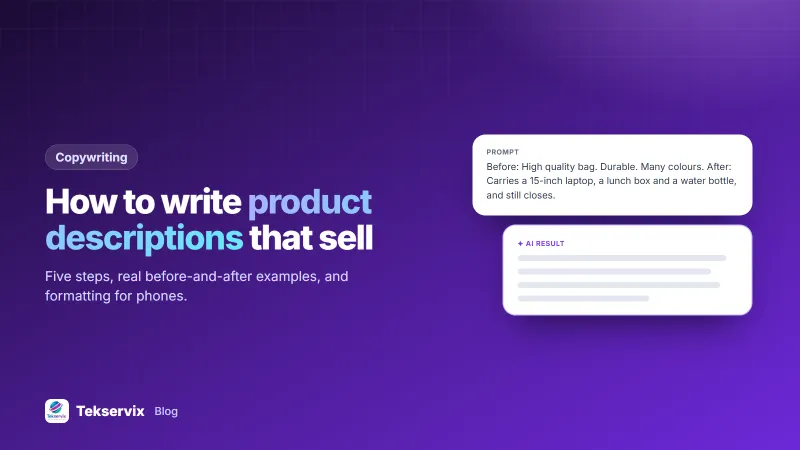
Before: High quality bag. Durable. Many colours available.
After: Carries a 15-inch laptop, a lunch box and a 1-litre water bottle, and still zips shut. Made from water-resistant canvas with double-stitched straps, in black, olive and sand.
The second version never says "quality", yet it shows it.
Step 4: Answer the objections#
Every product has a reason someone hesitates. Deal with it in the description rather than hoping they won't notice:
- Size and fit: give measurements and a comparison: "fits true to size; if you're between sizes, choose the larger".
- Price: explain what justifies it: materials, handmade, warranty, how long it lasts.
- Compatibility: "works with iPhone 12 to 16 and Android phones with USB-C".
- Risk: delivery time, returns and warranty in one clear line.
Step 5: Format for skimming#
Most shoppers read on a phone and scan before they read. A reliable structure:
- One or two sentences that say what it is and why someone would want it.
- Four to six bullets with the key benefits and specifics.
- Details below: dimensions, materials, care instructions, what's in the box.
- Delivery and returns in one line.
Keep paragraphs short and put the most important point at the start of each bullet.
A full example#
Handwoven Agaseke Basket, Medium
A lidded basket woven by hand from sisal and sweetgrass, sized for jewellery, keys or a small plant. Each one takes a weaver several days, so patterns vary slightly from basket to basket.
- Height 22 cm, diameter 14 cm
- Natural fibres, dyed with colour-fast dyes
- Tight weave keeps its shape for years
- Wrapped in tissue, ready to give as a gift
Ships within 2 working days. Returns accepted within 14 days if unused.
Write product descriptions for search, too#
- Use the words buyers type. "Laptop backpack" is searched far more than "commuter carry solution".
- Put the main phrase in the product title and first sentence, once, naturally.
- Write unique text for every product. Copied manufacturer text is the same on hundreds of sites. Our guide to duplicate content explains why that matters.
- Add structured data for price, availability and reviews so search results can show them. Google's product structured data guide lists the fields.
- Write a proper title tag and meta description for each product page; see our title tag guide.
Tone: sound like your shop#
A children's toy shop and a supplier of industrial tools shouldn't sound alike. Decide on three words for your voice, such as "warm, practical, local", and check each description against them. Read it out loud. If you wouldn't say it to a customer standing in front of you, rewrite it.
Writing at scale#
If you have hundreds of products, write a template for each category: which facts always go in the bullets, what the opening sentence must cover, which objection to address. Then fill it product by product. An AI product description generator can produce the first draft from your product details in seconds, and our guide to using one well is in AI product descriptions. Always check the facts and add the details only you know.
Checklist#
- Is it clear who it's for in the first two sentences?
- Does every benefit have a specific fact behind it?
- Are size, compatibility and price objections answered?
- Can someone get the gist in five seconds on a phone?
- Is it unique, with the main search phrase used naturally?
- Are delivery and returns stated?
- Is every claim true?
Good photos help the words do their job; our guide to white background product photos covers the images.
Frequently asked questions
How long should a product description be?
Long enough to answer what a buyer needs before paying, and no longer. For simple items that's 50 to 150 words plus a few bullet points; for expensive or technical products, 300 words or more with a specifications table.
Should I copy the manufacturer's description?
It's better not to. The same text appears on every shop selling the product, so it gives search engines no reason to rank your page, and it rarely speaks to your customers. Rewrite it in your own words and add details only you know.
Where should keywords go in a product description?
Use the product's main search phrase in the title, the first sentence and naturally once or twice in the body. Write for the buyer first; if the keyword doesn't fit a sentence, leave it out of that sentence.

Tekservix Team
The team behind Tekservix
The Tekservix Team builds and supports Tekservix: WhatsApp and SMS APIs, AI tools, invoicing, PDF and SEO tools for growing businesses. We write practical, tested guides based on what we see our customers do every day.
More articles from the Tekservix Team