How to Track Business Expenses: A Simple System for Small Businesses
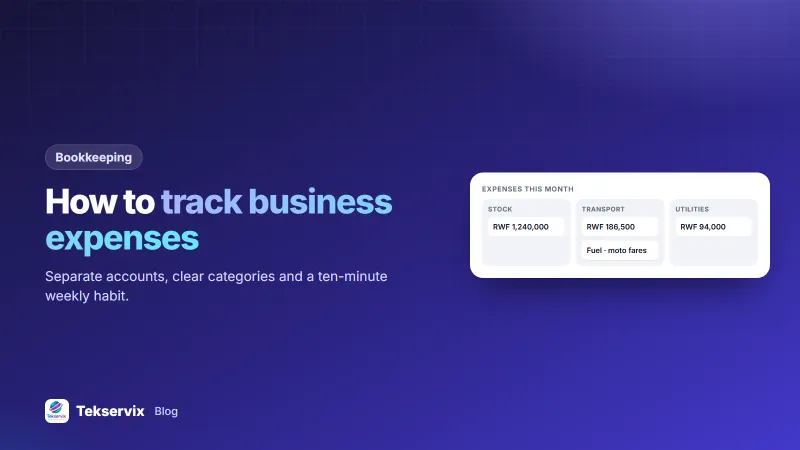
A simple way to track business expenses: separate accounts, clear categories, a receipt habit and a monthly review, so you know your real profit and are ready at tax time.
On this page
- Why it's worth the effort
- Step 1: Separate business and personal money
- Step 2: Choose a few clear categories
- Step 3: Capture every receipt the same day
- Step 4: Record each expense properly
- Step 5: A weekly catch-up and a monthly review
- Cash is the hard part
- Recurring costs deserve a list of their own
- A worked example
- Tools that make it easier
Most small business owners know their sales roughly. Far fewer know their costs, and that's where profit leaks: a transport bill that doubled, a subscription nobody uses, mobile money fees adding up quietly. Learning to track business expenses properly takes a simple system and a small weekly habit, not an accounting degree.
Why it's worth the effort#
- You see your real profit. Sales minus expenses is the only number that tells you whether the business is working.
- You pay the right tax. Business expenses you can prove usually reduce taxable profit, and you're ready if the tax office asks questions.
- You spot problems early. A cost that creeps up month after month is easy to fix once you can see it.
- You can price properly. Without knowing your costs, prices are guesses. See our guide on how to price a product.
Step 1: Separate business and personal money#
This single change makes everything else easier. Open a separate bank account, or at least a separate mobile money line, for the business. Pay business costs from it and pay yourself a fixed amount from it into your personal account. When the two are mixed, every transaction needs a decision about whether it was business or personal, and months later nobody remembers.
Step 2: Choose a few clear categories#
Categories let you see where money goes. Keep the list short enough to remember:
| Category | Examples |
|---|---|
| Stock and materials | Goods for resale, raw materials, packaging |
| Rent and utilities | Shop rent, electricity, water |
| Staff | Salaries, casual labour, social security contributions |
| Transport | Fuel, moto and taxi fares, delivery fees |
| Marketing | Ads, printing, sponsored posts |
| Phone, internet and software | Airtime, data bundles, subscriptions |
| Professional fees | Accountant, lawyer, registration fees |
| Bank and payment charges | Account fees, mobile money and card fees |
| Equipment | Computers, tools, furniture |
| Other | Anything that doesn't fit, reviewed monthly |
If "Other" grows big, create a new category. Your accountant may map these to formal account codes later; that's fine.
Step 3: Capture every receipt the same day#
Receipts get lost in pockets, fade in the sun and disappear in bags. The rule that works: photograph it the day you get it, and note what it was for. "Fuel, delivery to Nyamata" is far more useful at the end of the year than a blurry number.
For costs without a paper receipt, such as moto fares or market purchases, record them straight away with the date and purpose. For mobile money payments, the transaction SMS is a useful record; save or screenshot it with a note.
Step 4: Record each expense properly#
Every expense record needs the same few fields:
- Date
- Amount, and tax if shown
- Who you paid
- Category
- How you paid (bank, cash, mobile money, card)
- A short note on what it was for
- The receipt photo
A spreadsheet with these columns works to start with. An expense tracker saves time once you have more than a few dozen expenses a month, because it adds totals by category and keeps the receipts with the records.
Step 5: A weekly catch-up and a monthly review#
Weekly, ten minutes: record anything missing, attach receipts, and check your account balance matches what you expected.
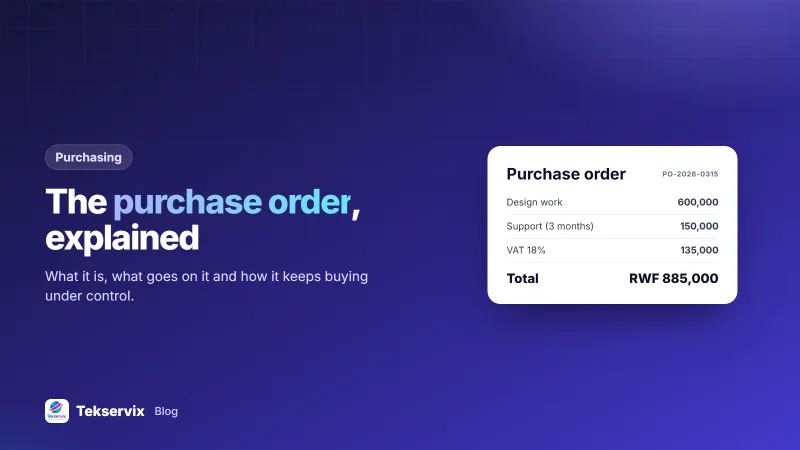
Monthly, thirty minutes: compare expenses by category with last month, look for anything unusual, and put sales and expenses side by side. That's the core of a profit and loss statement. Ask of each category: is this helping the business earn, and can it be cheaper?
Cash is the hard part#
Cash expenses disappear from records most easily. A few habits help:
- Keep a small, fixed petty cash float and top it up only against recorded expenses.
- Write every cash payment in a notebook or phone note at the moment you pay.
- Count the float weekly. The difference between what you have and what you should have is your unrecorded spending.
Recurring costs deserve a list of their own#
Rent, internet, software subscriptions and insurance come back every month or year. Keep a separate list with the amount, the date it renews and whether you still need it. Twice a year, go through the list and cancel what nobody uses. Subscriptions are the classic slow leak: small enough to ignore individually, noticeable together.
A worked example#
Consider a small catering business whose sales look healthy but whose bank balance never grows. After two months of tracking, the owner finds that transport has risen to nearly a fifth of costs, because ingredients are bought in small daily trips. Switching to two larger weekly market runs, and charging a delivery fee for events outside town, brings transport back down. None of that was visible until the costs were written down by category.
Tools that make it easier#
The Tekservix Business Suite includes an expenses section where you record costs by category alongside your invoices, so income and spending sit in one place and profit is calculated for you. For one-off sales documents, the free invoice generator produces branded invoices and receipts you can keep with your records. For general guidance on what counts as a deductible business expense, check your tax authority's guidance; in the UK, for example, GOV.UK's page on allowable expenses is a clear illustration of the principle, and our bookkeeping guide for small businesses covers the wider routine.
Keep every receipt suppliers give you; our guide to invoice vs receipt explains what each document proves.
Frequently asked questions
What is the easiest way to track business expenses?
Pay business costs from one dedicated account or mobile money line, photograph every receipt the day you get it, and record each expense with a date, amount, category and note. A weekly ten-minute catch-up keeps it from piling up.
How long should I keep business receipts?
It depends on your country's tax rules, and it's often several years. Check with your tax authority or accountant and keep digital copies, because paper receipts fade.
Which expense categories should a small business use?
Start with ten or fewer that match how you think about costs: stock or materials, rent, salaries, transport, marketing, utilities, phone and internet, software, professional fees and bank or mobile money charges.

Tekservix Team
The team behind Tekservix
The Tekservix Team builds and supports Tekservix: WhatsApp and SMS APIs, AI tools, invoicing, PDF and SEO tools for growing businesses. We write practical, tested guides based on what we see our customers do every day.
More articles from the Tekservix Team