Quote vs Invoice: What's the Difference and When to Send Each
A quote offers a price before the work; an invoice asks for payment after it. Here's how they differ, when to send each and how to turn one into the other.
On this page
A customer asks "can you send me something?" and you're not sure whether they want a quote or an invoice. Sending the wrong one causes real confusion: an invoice sent too early can end up recorded as a debt in the customer's books, and a quote sent after the work leaves you without a request for payment. Understanding quote vs invoice is simple once you see what each one is for.
The short answer#
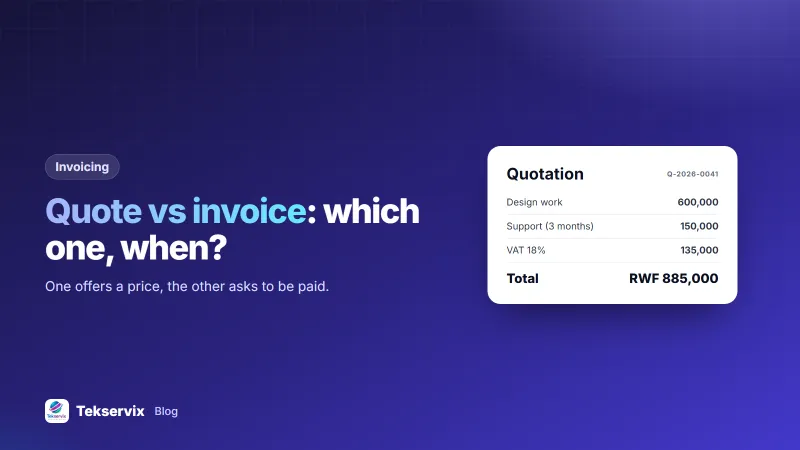
A quote is an offer: it tells the customer what you'll do and what it will cost, before they commit. An invoice is a request for payment: it tells the customer what they owe for goods or work that has been agreed or delivered.
The quote comes first and helps the customer decide. The invoice comes after the decision and helps you get paid.
Side by side#
| Quote | Invoice | |
|---|---|---|
| When | Before the sale | After the sale or delivery (or at agreed milestones) |
| Purpose | Offer a price and scope | Request payment |
| Key date | Valid until | Due date |
| Customer action | Accept, negotiate or decline | Pay |
| In your accounts | Not recorded | Recorded as a sale and a receivable |
| Tax | Shows expected tax | Must meet tax invoice rules where you're registered |
What goes on a quote#
- The word "Quotation" and a quote number.
- Your business details and the customer's.
- A clear description of the work or goods, with quantities and unit prices.
- Taxes and the total.
- What's not included, so there are no arguments later.
- A validity date, such as "valid for 30 days".
- Payment terms you'll apply if it's accepted, such as a 50% deposit.
- How to accept: sign, reply, or click an accept link.
Our step-by-step guide on how to write a quotation covers the wording in detail.
What goes on an invoice#
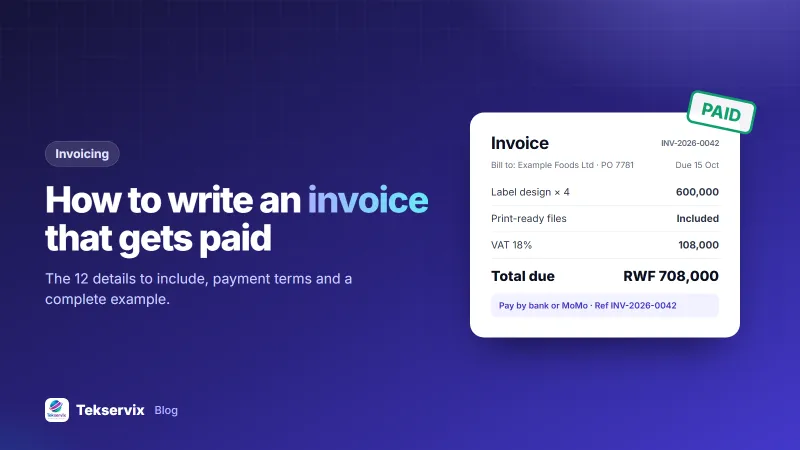
- The word "Invoice" and a unique, sequential invoice number.
- Issue date and due date.
- Your details, including tax registration number if you have one, and the customer's.
- Line items, taxes and total due, and any deposit already paid.
- How to pay: bank details, mobile money number or a payment link.
- A reference to the quote or purchase order, if there was one.
Quote, estimate and proforma: related but different#
An estimate is a rough figure, usually when the final cost isn't known yet, such as repairs where the damage isn't fully visible. A quote is a firm price for a defined scope. A proforma invoice is a formal, detailed preview of an invoice, often used for deposits, bank payments and imports. If a customer's bank or customs agent is involved, they probably need a proforma; our guide to the proforma invoice explains when.
The typical flow#
- Enquiry: the customer describes what they need.
- Quote: you send the price and scope.
- Acceptance: the customer accepts, sometimes after negotiation. Keep a record of the version they accepted.
- Deposit invoice (optional): for larger jobs, invoice the deposit right away.
- Delivery: you do the work or ship the goods.
- Final invoice: for the full amount, minus any deposit.
- Receipt: once payment arrives, confirm it. Our article on invoice vs receipt explains that last step.
An example#
A web designer is asked to build a five-page website. They send a quote: design and build of five pages, contact form, basic SEO setup, one round of revisions, RWF 900,000, valid for 21 days, 40% deposit on acceptance. Hosting and copywriting are listed as not included. The client accepts. The designer immediately issues an invoice for the RWF 360,000 deposit, references the quote number, and starts once it's paid. On launch day, the final invoice is for RWF 540,000, again referencing the quote. When the client later asks "why wasn't copywriting included?", the accepted quote answers the question.
Mistakes that cost money#
- No expiry on quotes. Someone accepts a year-old price after your costs have gone up.
- Vague scope. "Website design" invites endless revisions. List what's included.
- Invoicing before agreement. The customer hasn't accepted, and now there's an invoice in their system they didn't expect.
- Retyping the quote into the invoice. Every retype is a chance for a wrong price or a missing line.
- Changing a quote after acceptance without a new version. If scope changes, issue a revised quote and have it accepted again.
When to skip the quote#
Not every sale needs one. If you sell at a fixed, published price, such as a product in a shop or a service with a standard rate, the customer already knows the cost and you can go straight to an invoice or receipt. Quotes earn their keep when every job is different, when the amount is large enough that the customer needs approval, or when you want written agreement on what's included before you start.
Converting a quote to an invoice#
The cleanest way is to create the invoice directly from the accepted quote, so client details, items and prices carry over exactly. In the Tekservix Business Suite, the customer can accept a quote through a private link, and you convert it into an invoice in one step. For one-off documents, the free invoice generator creates estimates, proforma invoices and invoices with your logo and currency. If you need to check what your tax authority requires on an invoice, the Rwanda Revenue Authority publishes the rules for businesses registered in Rwanda; other countries have similar guidance from their tax office.
Frequently asked questions
Is a quote legally binding?
A quote becomes binding once the customer accepts it, in many jurisdictions, as long as it's specific about price and scope. That's why quotes should carry a validity date and clear terms. An estimate, by contrast, is usually treated as an approximate figure.
Can I send an invoice without a quote?
Yes. Many small sales never have a quote: a customer buys at a known price and receives an invoice or receipt. Quotes are useful when the price depends on the job, or when the customer needs approval before buying.
Should the quote and invoice have the same number?
No. Keep separate sequences, for example Q-2026-0041 for quotes and INV-2026-0187 for invoices, and reference the quote number on the invoice so the two can be matched later.

Tekservix Team
The team behind Tekservix
The Tekservix Team builds and supports Tekservix: WhatsApp and SMS APIs, AI tools, invoicing, PDF and SEO tools for growing businesses. We write practical, tested guides based on what we see our customers do every day.
More articles from the Tekservix Team